Your 2027 ICP Is Hiding in Your Win-Loss Data
It's Q4. Somewhere in your 2027 planning doc there's a slide titled "ICP," and odds are it looks a lot like the 2026 version: same industries, same employee bands, same revenue range — maybe one new vertical because the board asked about it.
That's not an ICP update. That's last year's ICP with a new date on it.
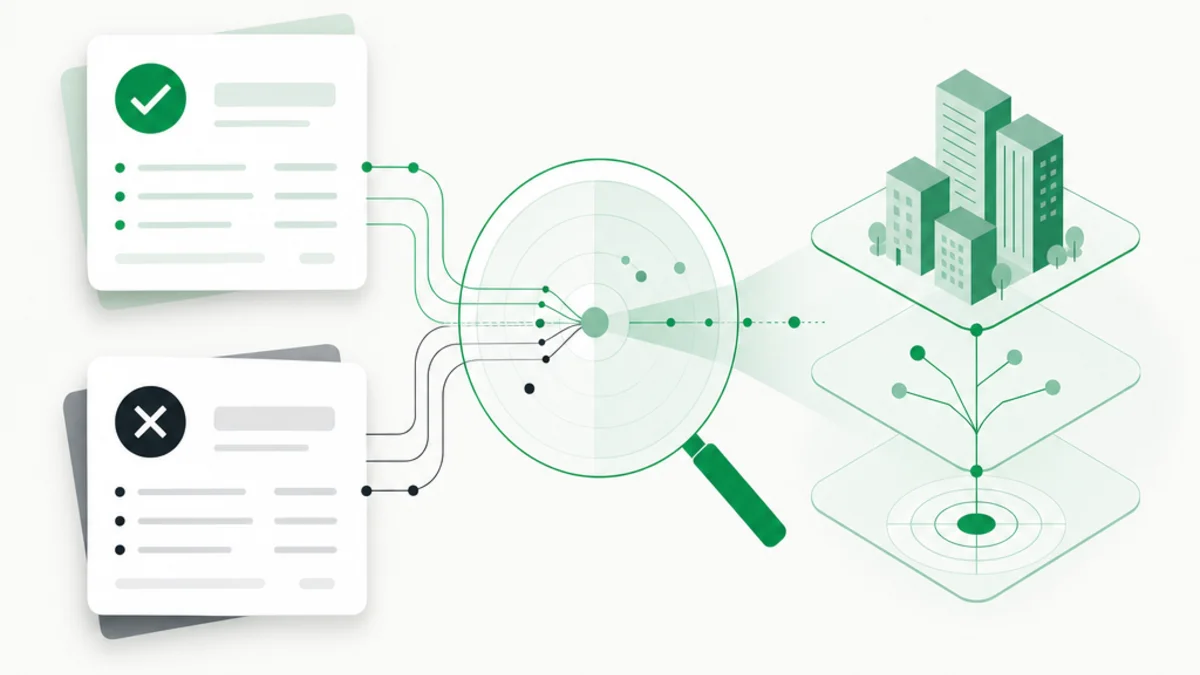
The data you need to actually rebuild your ideal customer profile already exists. It's sitting in your CRM as closed-won and closed-lost deals, and every one of them records why a buying group said yes or no. This Q4, put it to work.
Firmographics tell you who could buy. Win-loss tells you who did — and why.
A firmographic ICP defines your addressable universe. It doesn't tell you who's ready. Two healthcare providers can share the same size, region, and revenue — and only one of them is expanding virtual care and needs a network that can support it. Same ICP row. Completely different deal.
Win-loss data closes that gap. Every win or loss reason describes the deal, but it also points to what was happening inside the company at the time. Most of those characteristics fall into five groups:
- Growth or expansion — new locations, new service lines, funding, rapid hiring
- Technology change — a migration, a platform replacement, tool consolidation
- Leadership and personnel — a new executive, a new team, a reorg
- Operational sophistication — whether the team has the skills and roles to adopt a solution
- Timing — budget cycles, contract renewals, competing priorities
Each of these leaves observable evidence: job postings, leadership changes, tech stack shifts, new locations. That evidence is what we call Exegraphics — need signals derived from AI models trained on real buying behavior. They describe how a company operates, not just what it looks like on paper.
The payoff is real. According to Gartner research, companies with a comprehensive win-loss approach see a 15–30% revenue increase and up to 50% improvement in win rates — driven in part by better segmentation. Your ICP is your segmentation. That's where the value lands.
Run the Win-Loss Signal Playbook as your ICP refresh
Our Win-Loss Signal Playbook lays out six steps for turning deal outcomes into exegraphic targeting. Run them in Q4 and each one answers a question your 2027 ICP needs to settle.
- Gather and validate win-loss data. Pull 6–12 months of closed-won and closed-lost deals for one segment, then confirm the reasons with sales. Don't skip validation — in side-by-side comparisons, buyer-reported reasons matched CRM entries only about 15% of the time. ICP question: which segment do we rebuild first?
- Decode reasons into account characteristics. For each reason, ask what was happening at the company that made it ready to buy — or not. Look for the characteristic that repeats across wins. ICP question: what does "ready" look like, beyond who fits?
- Translate characteristics into Exegraphics. Map each characteristic to the need signals that reveal it. Win signals become inclusion criteria. Loss signals become exclusion or timing criteria. ICP question: what signal layer sits on top of our firmographics?
- Apply signals in demand campaigns. Build signal-qualified audiences, exclusion lists, signal-specific messaging, and timing windows. ICP question: how does the ICP actually change who we reach in January?
- Pass signal intelligence to sales. Add a signal field to the CRM so every lead arrives with the reason it matched. ICP question: does sales work the same ICP marketing targets?
- Measure and refine. Compare signal-matched buying groups to the rest on engagement, opportunity conversion, win rate, and cycle length. ICP question: is our ICP right — and how will we know by Q2?
That last step matters most. It turns your ICP from an annual document into a hypothesis you test every quarter.
What a signal-based 2027 ICP looks like
A rebuilt ICP keeps your firmographics — then adds two layers that tell you who's ready now and who to wait on. Take a company selling networking infrastructure to healthcare providers, the worked example from the playbook:
| Layer | The question it answers | Example |
|---|---|---|
| Firmographic base | Who could buy? | US healthcare providers in our size range |
| Win signals | Who's ready now? | Hiring telehealth or virtual nursing roles; opening multi-site clinics |
| Loss signals | Who do we exclude or wait on? | No expansion signals; hiring freeze announced; competitor locked in (time outreach to the renewal) |
The 2026 ICP said "healthcare providers." The 2027 ICP says "healthcare providers expanding virtual care across sites" — and it can prove why, because the pattern came straight from the deals they won.
Notice the loss layer isn't just a blocklist. Many loss reasons are timing problems, not fit problems. "Not a priority this year" is a buying group to monitor, not one to drop. Watch for the signal that says the moment changed — new leadership, new hiring tied to a related initiative — then re-engage.
Your Q4 ICP checklist
You don't need to rebuild the whole ICP before January. Run one segment through the full loop this quarter, launch on it, and expand from there.
- Request 6–12 months of closed-won and closed-lost data for one segment
- Validate the most common win and loss reasons with sales
- Identify the account characteristics behind the reasons that repeat
- Map each characteristic to one or more need signals
- Rewrite that segment's ICP as three layers: firmographic base, win signals, loss signals
- Build a signal-qualified audience and an exclusion list for your first 2027 campaigns
- Add a signal field to lead handoffs so sales sees why each lead matched
- Set a date to compare signal-matched buying groups to the rest after one quarter
Stop recycling last year's ICP
Your wins already told you who to target in 2027. Your losses told you who to skip — or when to come back. The Q4 ICP exercise is the moment to listen.
GetRev turns the patterns in your wins and losses into Exegraphic Targeting, uses Campaign Simulation to predict response before you spend, and runs fully managed demand campaigns that reach the buying groups most likely to buy — with the signal attached to every lead. You get the results; we do the work.
Download The Win-Loss Signal Playbook →
Generate demand with AI precision.